> ## Documentation Index
> Fetch the complete documentation index at: https://developers.pleo.io/llms.txt
> Use this file to discover all available pages before exploring further.
# Quickstart
**This page has now been ARCHIVED. Please visit:**
* **[OAuth 2.0 Setup Workflow Guide](/docs/current/guides/oauth-workflow-guide)**
* **[OAuth 2.0 Setup with Postman Workflow Guide](/docs/current/guides/oauth-workflow-guide-postman)**
* **[API Keys Workflow Guide](/docs/current/guides/standalone-api-keys-workflow-guide)**
Welcome to the Pleo API! We're here to help you get connected fast. This Quickstart guide walks you through using an API key to get up and running.
### Introduction
There are two ways to authenticate:
* [OAuth 2.0](/docs/oauth-20)
* [API keys](/docs/api-keys)
For this guide, we will be using the **API keys flow** and assume you have a Pleo account.
### 1. Get your API key
1. Head to your Pleo account > Settings > Scroll down and click on [API keys](https://app.pleo.io/settings/api-keys)
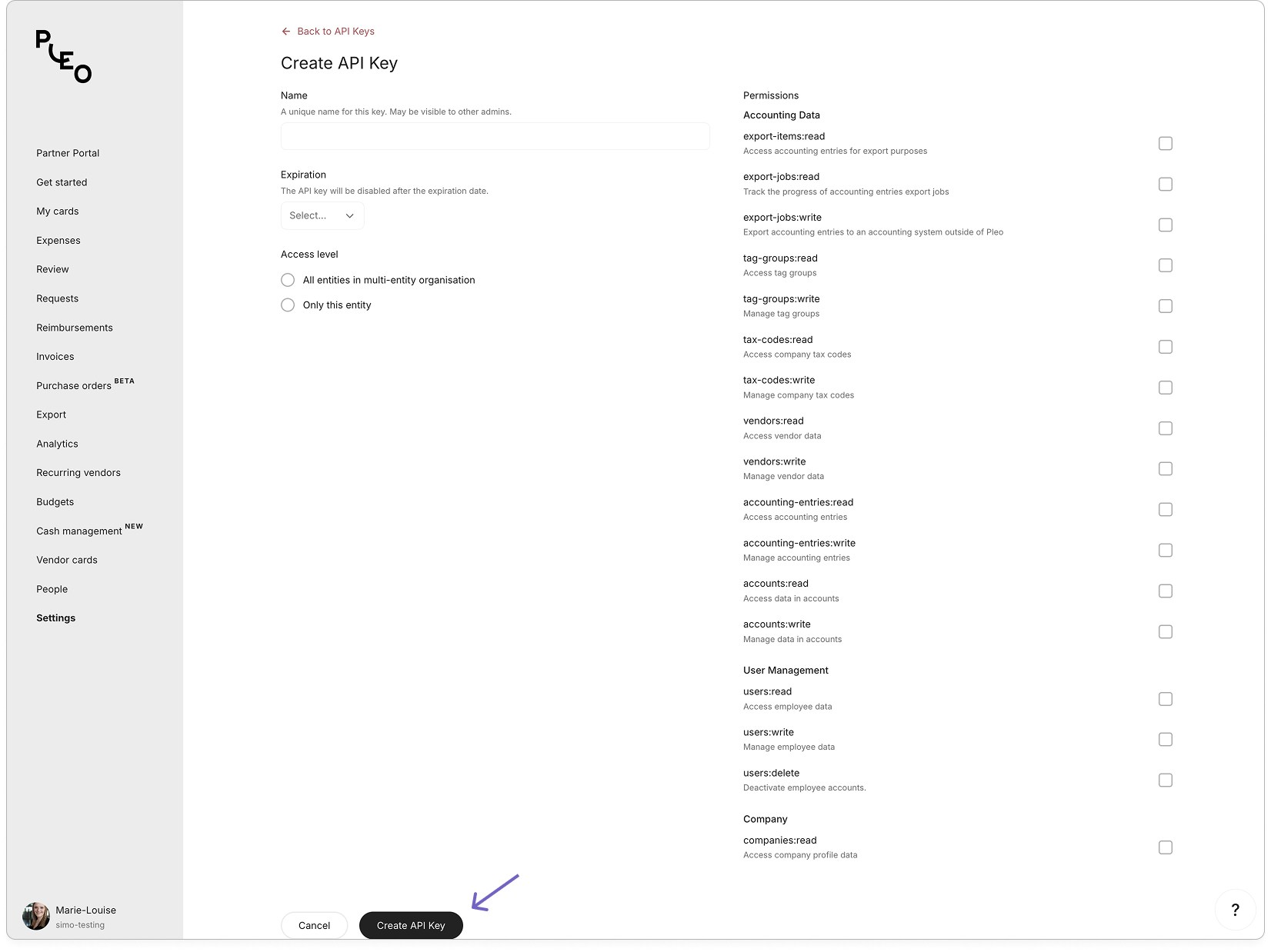
 2. Click on *Create API key*
 3. Add the following details
* **Name**: give your key a name that will help you remember what it's for, like `Pleo API Quickstart`
* **Expiration date**: choose when you want the key to expire
* **Access level**: decide if the key is for a specific entity (company) or for multiple entities of a business (organisation). [Read about the differences here](/docs/multi-entity-setup-with-pleo).
* **Permissions**: select the scopes you need. Your selections will automatically enable the right permissions in your key.
4. Click on *Create API Key*
3. Add the following details
* **Name**: give your key a name that will help you remember what it's for, like `Pleo API Quickstart`
* **Expiration date**: choose when you want the key to expire
* **Access level**: decide if the key is for a specific entity (company) or for multiple entities of a business (organisation). [Read about the differences here](/docs/multi-entity-setup-with-pleo).
* **Permissions**: select the scopes you need. Your selections will automatically enable the right permissions in your key.
4. Click on *Create API Key*
 5. Store your key securely as you will only be able to see it once
### 2. Make your first API call
Time to put your new key to use!
When authenticating with API keys, include the key in the `Authorization` header of the request, using the `Basic` schema. The key should be used as the username, and an empty string should be used as the password.
We'll use the [Get Search for employees](/reference/employees/search-for-employees) query for this example.
**curl**
With curl, specify the `-u / --user` flag, followed by the API key. The password is an empty string.
```shell Request example theme={null}
curl --request GET \
--url https://external.pleo.io/v2/employees \
--header 'accept: application/json;charset=UTF-8' \
--header 'authorization: Basic API_KEY'
```
If the request is successful, you will receive a response such as:
```json Response example theme={null}
{
"data": [
{
"code": "string",
"companyId": "3fa85f64-5717-4562-b3fc-2c963f66afa6",
"email": "string",
"firstName": "string",
"id": "3fa85f64-5717-4562-b3fc-2c963f66afa6",
"jobTitle": "string",
"lastName": "string",
"phone": "string"
}
],
"pagination": {
"currentRequestPagination": {
"after": "string",
"before": "string",
"limit": 0,
"offset": 0,
"parameters": {
"additionalProp": [
"string"
]
},
"sortingKeys": [
"string"
],
"sortingOrder": [
"ASC"
]
},
"endCursor": "string",
"hasNextPage": true,
"hasPreviousPage": true,
"startCursor": "string",
"total": 0
}
}
```
**Postman**
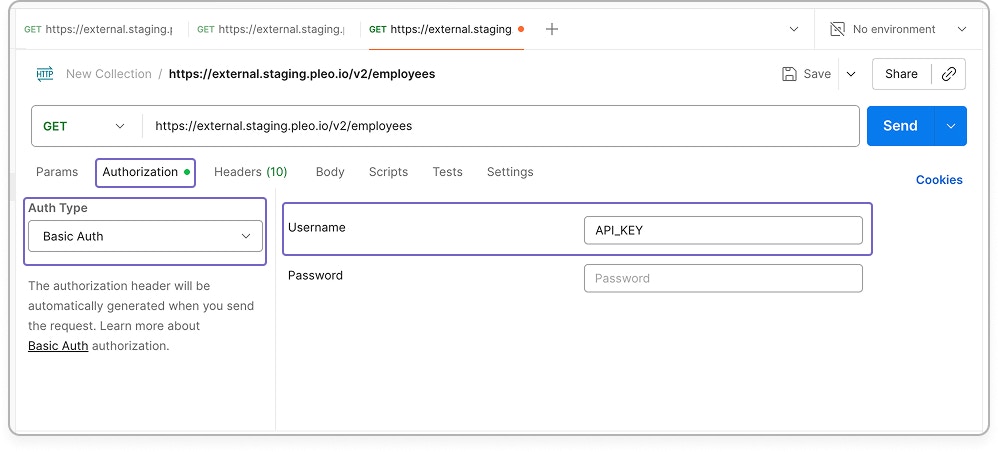
In Postman, you can specify the API key in the Authorization tab, selecting the Basic Auth type, and using the API key as the username, and an empty string as the password.
5. Store your key securely as you will only be able to see it once
### 2. Make your first API call
Time to put your new key to use!
When authenticating with API keys, include the key in the `Authorization` header of the request, using the `Basic` schema. The key should be used as the username, and an empty string should be used as the password.
We'll use the [Get Search for employees](/reference/employees/search-for-employees) query for this example.
**curl**
With curl, specify the `-u / --user` flag, followed by the API key. The password is an empty string.
```shell Request example theme={null}
curl --request GET \
--url https://external.pleo.io/v2/employees \
--header 'accept: application/json;charset=UTF-8' \
--header 'authorization: Basic API_KEY'
```
If the request is successful, you will receive a response such as:
```json Response example theme={null}
{
"data": [
{
"code": "string",
"companyId": "3fa85f64-5717-4562-b3fc-2c963f66afa6",
"email": "string",
"firstName": "string",
"id": "3fa85f64-5717-4562-b3fc-2c963f66afa6",
"jobTitle": "string",
"lastName": "string",
"phone": "string"
}
],
"pagination": {
"currentRequestPagination": {
"after": "string",
"before": "string",
"limit": 0,
"offset": 0,
"parameters": {
"additionalProp": [
"string"
]
},
"sortingKeys": [
"string"
],
"sortingOrder": [
"ASC"
]
},
"endCursor": "string",
"hasNextPage": true,
"hasPreviousPage": true,
"startCursor": "string",
"total": 0
}
}
```
**Postman**
In Postman, you can specify the API key in the Authorization tab, selecting the Basic Auth type, and using the API key as the username, and an empty string as the password.
 ### Errors
We use standard HTTP status codes to let you know if a request was successful or if there was an issue. For a full list of codes and what they mean, check out our [API Response Codes | Errors guide](/reference/api-response-codes-errors-1).
### Next steps
Congrats, you've just completed the Quickstart 🎉 We recommend checking the [Authorization guide](/docs/authentication-authorisation-introduction) next.
**What’s Next**
[Introduction ->](/docs/authentication-authorisation-introduction)
### Errors
We use standard HTTP status codes to let you know if a request was successful or if there was an issue. For a full list of codes and what they mean, check out our [API Response Codes | Errors guide](/reference/api-response-codes-errors-1).
### Next steps
Congrats, you've just completed the Quickstart 🎉 We recommend checking the [Authorization guide](/docs/authentication-authorisation-introduction) next.
**What’s Next**
[Introduction ->](/docs/authentication-authorisation-introduction)