> ## Documentation Index
> Fetch the complete documentation index at: https://developers.pleo.io/llms.txt
> Use this file to discover all available pages before exploring further.

# How to Make an API Call (Postman)

export const WhatComesNext = ({children, href}) => <div className="mt-4">
    <a href={href} className="
        inline-flex items-center justify-center
        rounded-full
        bg-black text-white dark:bg-[#1f262b]
        px-5 py-2.5 text-sm font-medium
        no-underline border-0
        hover:bg-[#ffe6ea] dark:hover:bg-[#2b1f23]
        hover:text-black
        transition-colors
      ">
      {children} →
    </a>
  </div>;

This how-to covers making an API call using OAuth 2.0 and **Postman**. For the full non-Postman setup, where you manage the entire token lifecycle, see the [OAuth 2.0 Setup Workflow Guide](/docs/current/guides/oauth-workflow-guide) instead.

## Prerequisites

Before you begin:

* You have [configured Postman](/docs/current/how-tos/oauth-postman/how-to-configure-postman-for-oauth) for OAuth 2.0

## Steps

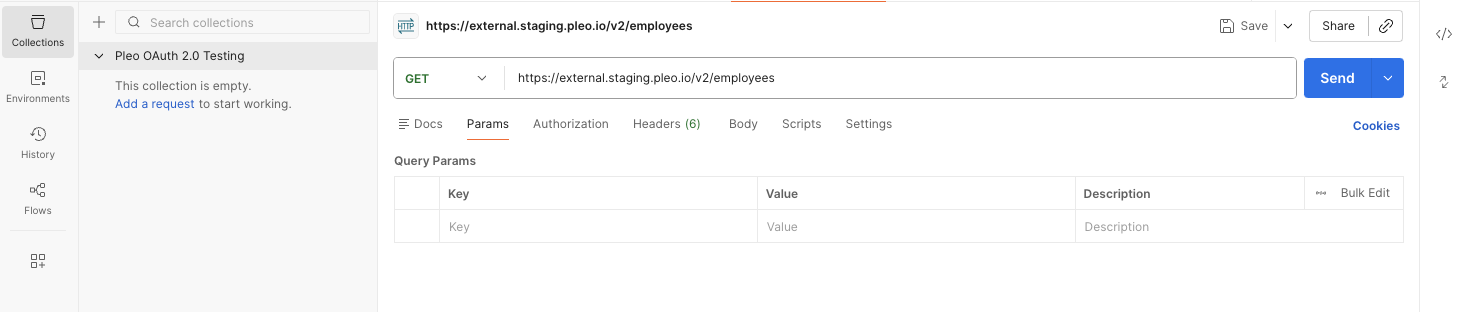
### 1. Create an HTTP Request

In the Postman collection where you've configured OAuth 2.0:

1. Click **New** and then select **HTTP Request**
2. Ensure that the HTTP method corresponds to the endpoint being called, for example: `GET`
3. Enter the **Staging URL** for the Pleo API you want to test, for example: `https://external.staging.pleo.io/v2/employees`

<div style={{ textAlign: "center" }}>
  <img src="https://mintcdn.com/pleo-61d4d38b/rw-misT-UerICD29/images/current/oauth-postman/oauth-postman-api-url.png?fit=max&auto=format&n=rw-misT-UerICD29&q=85&s=1834a90de0a93965d64d96665aaaa797" alt="Postman GET HTTP Request" width="100%" style={{ display: "block", margin: "0 auto" }} data-path="images/current/oauth-postman/oauth-postman-api-url.png" />
</div>

<Note>
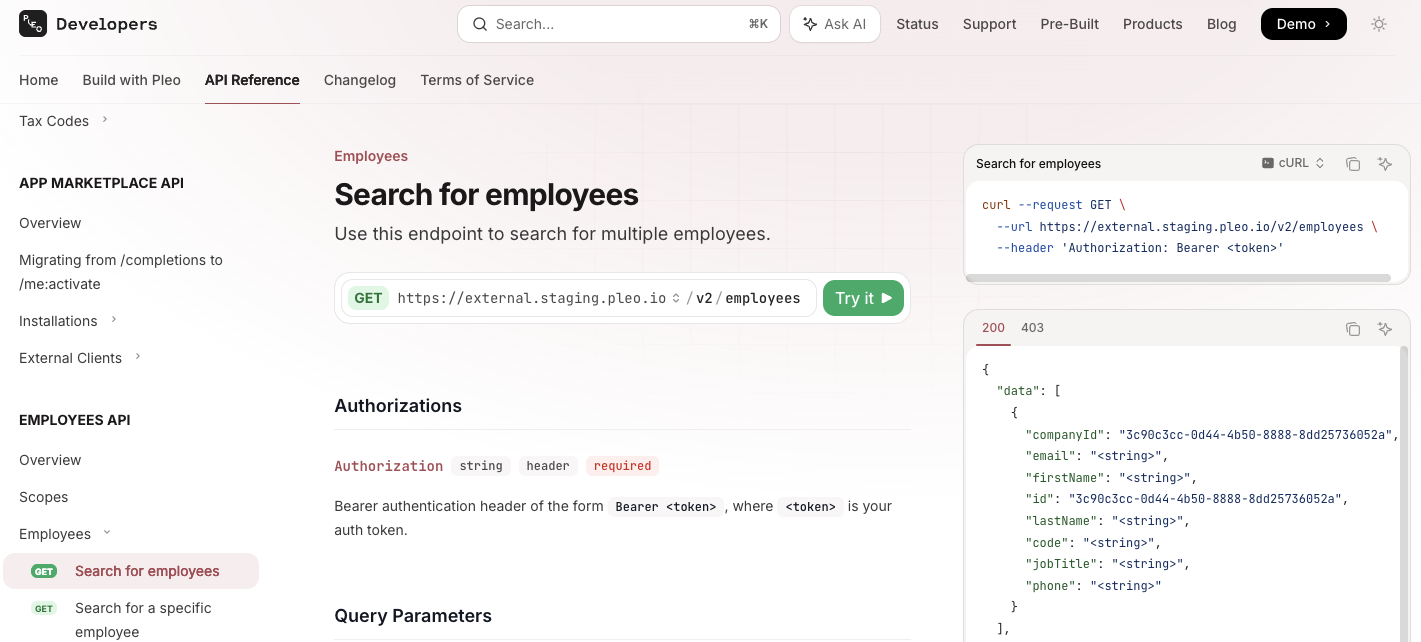
  Each API endpoint has both a **Staging** and a **Production** URL. You can find these in the [Pleo API Reference](https://developers.pleo.io/reference/employees/search-for-employees) sections.

  <div style={{ textAlign: "center" }}>
    <img src="https://mintcdn.com/pleo-61d4d38b/rw-misT-UerICD29/images/current/oauth-postman/oauth-postman-api-url-endpoint-in-docs.png?fit=max&auto=format&n=rw-misT-UerICD29&q=85&s=3a56c9d6ca1036204bbacb00d29ae5c6" alt="Pleo API URLs in docs" width="100%" style={{ display: "block", margin: "0 auto" }} data-path="images/current/oauth-postman/oauth-postman-api-url-endpoint-in-docs.png" />
  </div>
</Note>

### 2. Add authorisation

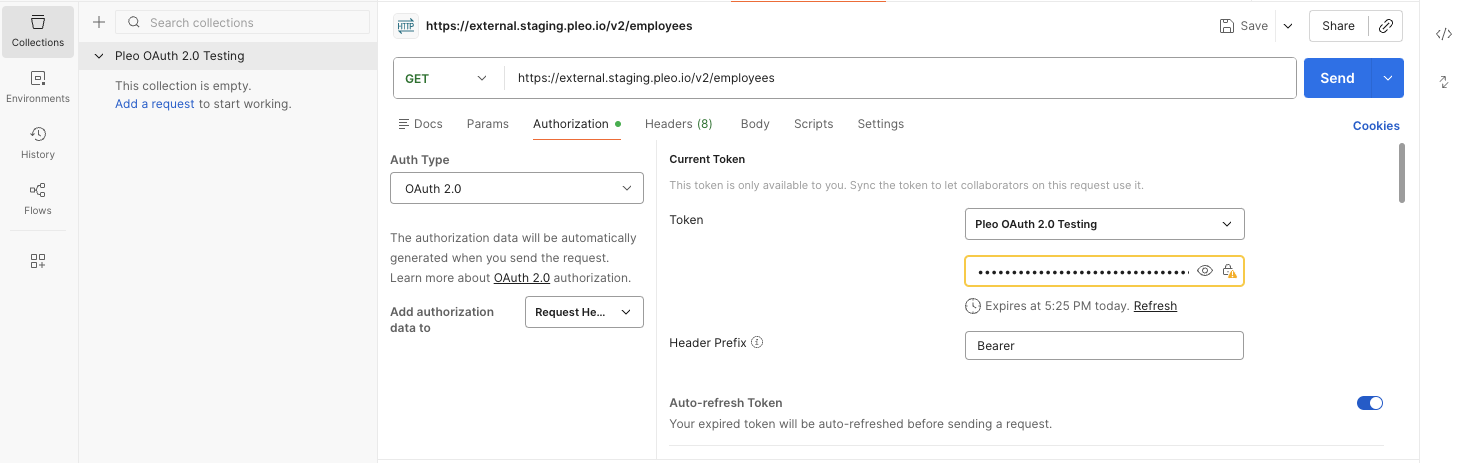
1. Click the **Authorization** tab
2. Select **OAuth 2.0** as the **Auth Type**
3. Select the OAuth 2.0 token you previously created from the **Token** dropdown menu
4. Postman automatically injects: `Authorization: Bearer <access_token>`

<div style={{ textAlign: "center" }}>
  <img src="https://mintcdn.com/pleo-61d4d38b/rw-misT-UerICD29/images/current/oauth-postman/oauth-postman-api-auth-type.png?fit=max&auto=format&n=rw-misT-UerICD29&q=85&s=ecdfb0f380c8cfd5dab63451ad56fe80" alt="Postman Auth Type" width="100%" style={{ display: "block", margin: "0 auto" }} data-path="images/current/oauth-postman/oauth-postman-api-auth-type.png" />
</div>

### 3. Send the request

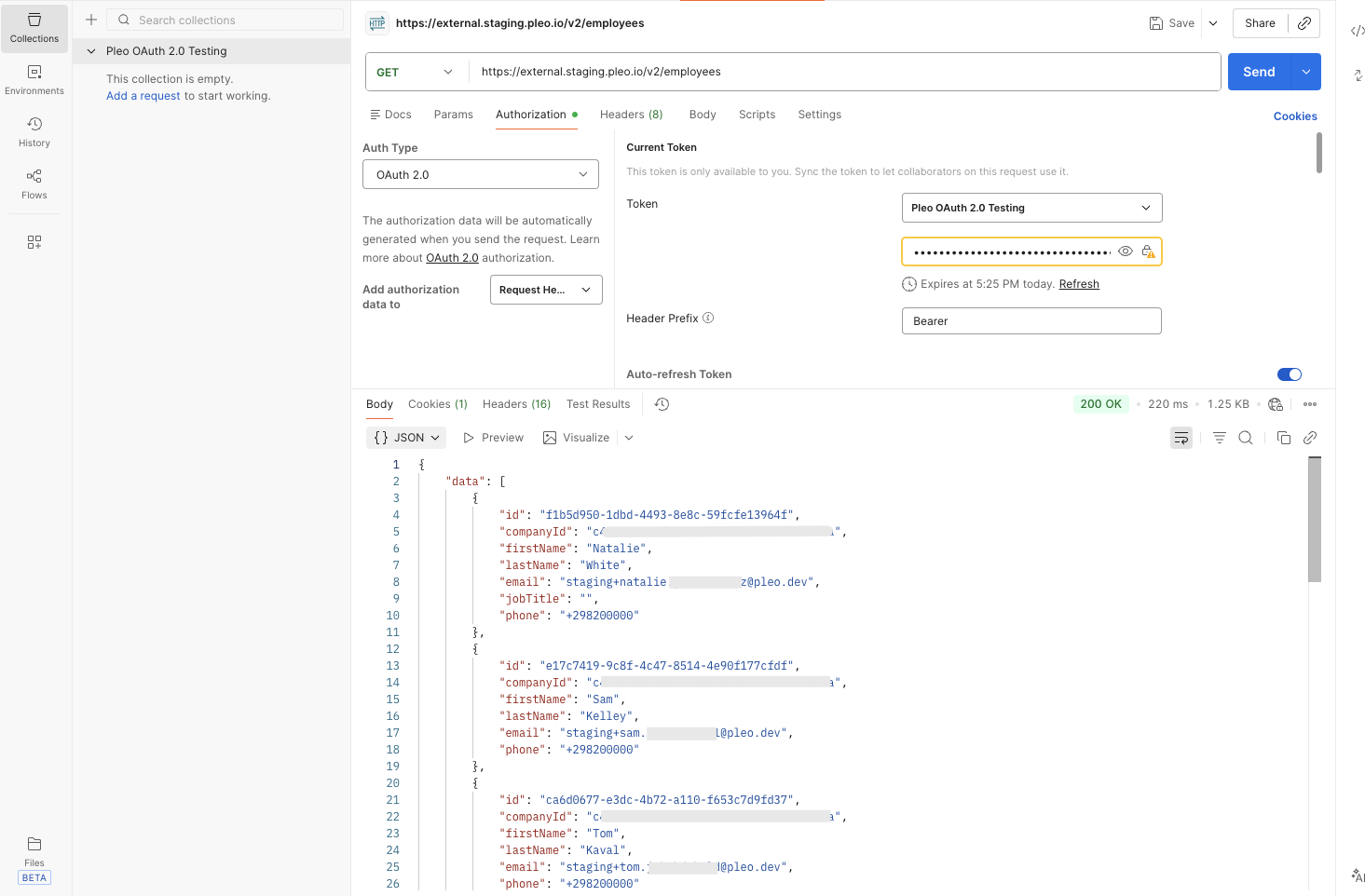
1. Click the **Send** button at the top of the screen
2. If everything is configured correctly, you should receive a JSON response

<div style={{ textAlign: "center" }}>
  <img src="https://mintcdn.com/pleo-61d4d38b/rw-misT-UerICD29/images/current/oauth-postman/oauth-postman-api-results.png?fit=max&auto=format&n=rw-misT-UerICD29&q=85&s=cc513446a829920259e8f6c878635d7d" alt="Postman Auth Type" width="100%" style={{ display: "block", margin: "0 auto" }} data-path="images/current/oauth-postman/oauth-postman-api-results.png" />
</div>

## Result

After completing these steps:

* You have successfully made a Pleo API call using OAuth 2.0 in Postman

## What Comes Next?

<WhatComesNext href="/docs/current/guides/oauth-workflow-guide-postman#3-make-a-pleo-api-call-using-postman">
  Go back to guide
</WhatComesNext>

***

<div className="text-xs uppercase" style={{ fontVariant: 'small-caps' }}>
  this how-to is part of:
</div>

<div className="mt-4 flex flex-wrap gap-2">
  <a
    href="/docs/current/guides/oauth-workflow-guide-postman"
    className="inline-flex items-center rounded-full border border-gray-300 dark:border-gray-600 
px-3 py-1 text-xs font-medium 
bg-white dark:bg-[#1f262b] text-black dark:text-white
hover:bg-gray-100 dark:hover:bg-[#2b2f33]
transition-colors"
  >
    OAuth 2.0 Setup with Postman Workflow Guide
  </a>
</div>

***

## Related Reading

* [OAuth 2.0 Setup Workflow Guide](/docs/current/guides/oauth-workflow-guide)

  Step-by-step instructions on how to configure OAuth 2.0 where you handle the full token lifecycle

***